Best Free Chinese AI Writing Tools in 2026: 8 Tested & Compared — Find the Right One for You
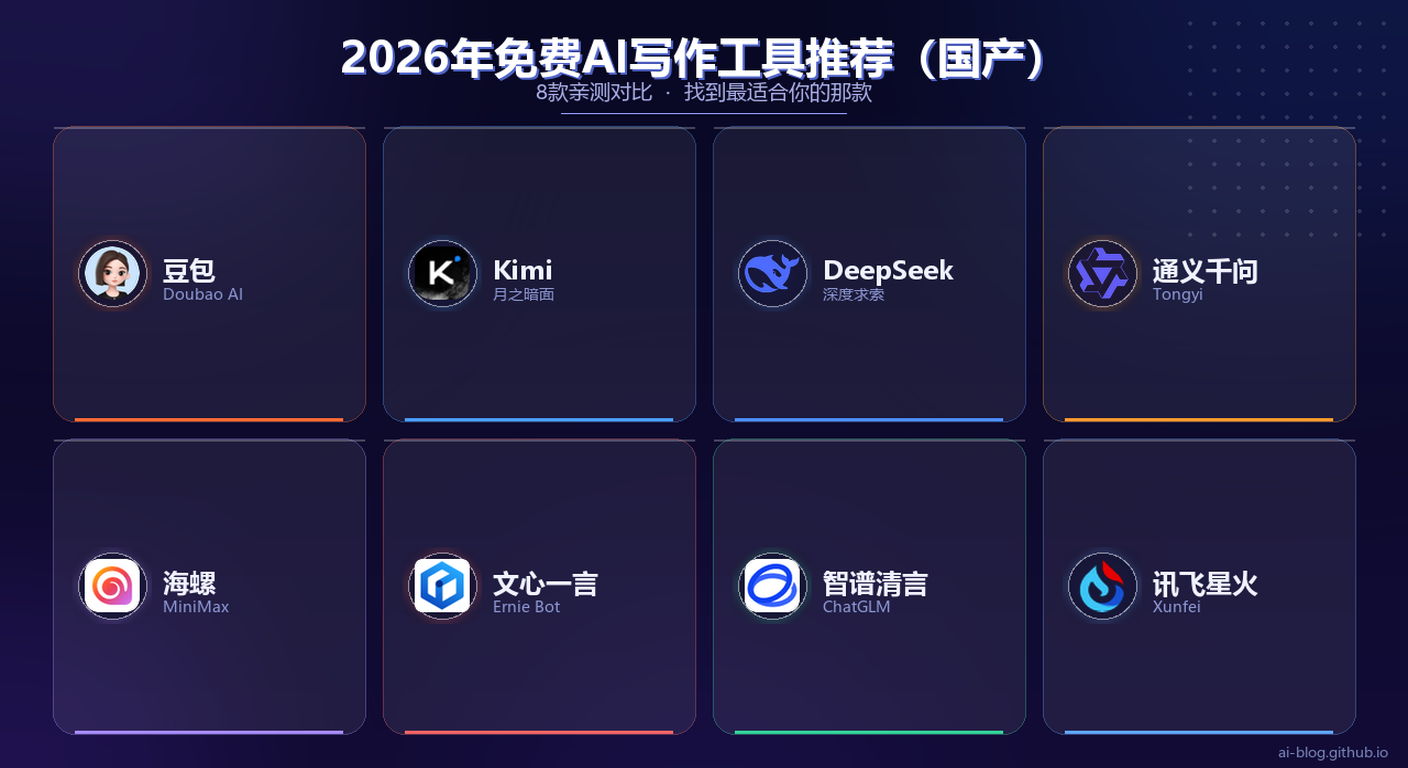
Want to use AI for writing but not sure which Chinese tool is actually worth it? You’re not alone. Using ChatGPT over a VPN is unreliable, and paying for tools feels risky when you haven’t tried them. The good news: by 2026, the free domestic AI writing tool space in China has matured significantly — Doubao, Kimi, DeepSeek, ERNIE Bot… there are over a dozen well-known options.
This article walks you through 8 mainstream free Chinese AI writing tools, with a comparison table and clear scene-based recommendations. No fluff — just a straight answer on which one to use.
TL;DR: For everyday writing, go with Doubao or Kimi. For deep content and logical reasoning, choose DeepSeek. Students writing papers should combine Kimi + DeepSeek. For workplace documents, use Tongyi Qianwen. For web fiction, use MiniMax Hailuo.
Why Choose Free Chinese AI Writing Tools?
No VPN Needed — More Stable Access
Anyone who’s used ChatGPT knows the frustration — dropping mid-session, or waking up to find you need a new proxy node. Chinese tools run on domestic servers. Doubao, Kimi, DeepSeek — you open them and they work, via web or app, seamlessly switching between phone and computer. The reliability difference is night and day.
For people who rely on AI assistance daily, stability matters more than almost anything else. A tool that randomly cuts out — no matter how capable — will drive you crazy.
Better Understanding of Chinese Context
Domestic models invest more heavily in Chinese training data, which gives them a clear edge on Chinese writing tasks. For content like Xiaohongshu posts, WeChat articles, or workplace reports, Doubao and ERNIE Bot produce text that feels genuinely Chinese — no translation awkwardness.
Kimi excels particularly at processing long Chinese documents. Upload a report that’s tens of thousands of characters and ask it to summarize or rewrite — accuracy is noticeably higher than most international tools. DeepSeek’s Chinese logical reasoning also ranked near the top of domestic evaluations in early 2026.
More Generous Free Tiers
This is an advantage many people overlook. Doubao’s core features are completely free with 500 AI interactions per month. Kimi’s free tier supports very long context windows. DeepSeek’s web version has essentially no usage limits. ERNIE Bot made all basic features free starting April 2025. For individual users, these free tiers are more than enough — you can get solid AI writing assistance without spending a cent.
If you want a broader framework for choosing AI writing tools, check out this Complete Guide to AI Writing Tools for a more comprehensive overview.
2026 Free Chinese AI Writing Tools: Side-by-Side Comparison
What We Tested
Four dimensions:
- Free tier: How much can you use per day/month? Any character or request limits?
- Chinese writing quality: Fluency, accuracy, and natural feel of the generated content
- Best use case: Where does this tool genuinely stand out?
- Ease of use: Is the interface beginner-friendly? Can new users get started quickly?
Comparison Table
| Tool | Free Tier | Best Writing Use Case | Chinese Quality | Ease of Use |
|---|---|---|---|---|
| Doubao | 500 interactions/month, core features free | Social media copy, short-video scripts | ⭐⭐⭐⭐⭐ | Very Easy |
| Kimi | Free with very long context window | Long-form content, document analysis | ⭐⭐⭐⭐⭐ | Easy |
| DeepSeek | Web version essentially unlimited | Logical reasoning, academic writing | ⭐⭐⭐⭐ | Easy |
| ERNIE Bot | All basic features free | Search-enhanced writing, marketing copy | ⭐⭐⭐⭐ | Easy |
| Tongyi Qianwen | Full-featured free tier | Workplace documents, meeting notes | ⭐⭐⭐⭐ | Easy |
| Zhipu Qingyan | Free access to GLM-4 | Code + writing mixed tasks | ⭐⭐⭐⭐ | Medium |
| iFlytek Spark | Daily free usage limit | Voice transcription, educational content | ⭐⭐⭐ | Easy |
| MiniMax Hailuo | Basic free tier | Web fiction / novel writing | ⭐⭐⭐⭐ | Easy |
Detailed Reviews: 8 Free Chinese AI Writing Tools
Doubao
Made by ByteDance, with over 172 million monthly active users — the most-used AI app in China. For social media copy, Doubao is essentially best-in-class among domestic tools. Short-video scripts, Xiaohongshu-style posts, Weibo commentary — it produces content with real “internet feel” that other tools often make sound too formal.
The free tier gives 500 AI interactions per month, which is plenty for typical users. The interface is clean, the mobile app experience is excellent, and you can switch between devices seamlessly. The one minor downside: answers can sometimes feel overly cautious around sensitive topics.
Best for: Content creators, social media managers, anyone who needs to produce copy quickly.
Kimi
Made by Moonshot AI. The benchmark for long-document handling among Chinese AI tools. It supports uploading extremely long documents (up to hundreds of thousands of characters) and produces accurate summaries, rewrites, and key-point extractions. The writing style leans precise and thorough — good for content that needs depth.
The free context window is large enough to write a 3,000-character in-depth article without issues. The real-time web search feature is also very useful — it can look things up while writing, which reduces hallucinations.
Best for: Bloggers writing deep content, students, researchers.
DeepSeek
Made waves both in China and internationally in early 2026. DeepSeek V3.2’s performance on logical reasoning and Chinese comprehension has been ranked by multiple evaluations as the closest domestic equivalent to GPT-4o. The web version has essentially no usage limits — free to use without much worry.
For writing, DeepSeek particularly shines on content that requires tight logic — analytical reports, academic paper outlines, technical documentation. Its chain-of-thought reasoning produces more structured content with more persuasive argumentation.
Best for: Students, researchers, anyone who writes analysis-heavy content.
ERNIE Bot
Made by Baidu, integrated with Baidu Search, so it can pull real-time web information while writing — ideal for content that needs to be timely. All basic features became free in April 2025, including long-document processing.
Performs well for marketing copy and commercial writing. Baidu’s data advantage means higher quality in vertical niches like e-commerce and local services.
Best for: E-commerce operators, marketers, users who need real-time information in their writing.
Tongyi Qianwen
Made by Alibaba. Among the most reliable domestic tools for workplace documents. Meeting notes, work reports, project proposals — the content Tongyi Qianwen generates is well-formatted, logically clear, and usable as-is.
The free tier is full-featured, and its API capabilities are strong — suitable for technically inclined users who want to integrate AI writing into their workflow.
Best for: Office workers, enterprise users, developers with API needs.
Zhipu Qingyan
Made by Zhipu AI, built on the GLM model series. The GLM-5 released in February 2026 with 744B parameters is among the top-tier open-source domestic models. Writing capability is well-rounded, and it handles mixed code + text tasks particularly well.
The free tier gives access to GLM-4, which is more than sufficient for ordinary writing tasks. The interface is relatively clean — less flashy than Doubao, but consistently solid output quality.
Best for: Technical users, scenarios requiring mixed code and documentation output.
iFlytek Spark
Made by iFlytek, whose traditional strength is voice recognition. On the writing side, Spark performs well for educational content — lesson plans, study schedules, knowledge explanations — but lags behind Doubao and Kimi for creative writing and social media copy.
The free tier has a daily usage cap, which may be insufficient for heavy writing users. If your main need is voice-to-text followed by polishing, Spark is an excellent choice.
Best for: Educators, users who need voice transcription functionality.
MiniMax Hailuo
Made by MiniMax. Has a unique edge for creative writing and novel generation. Its long-form generation capability is strong — when writing web fiction, stories, or scripts, it maintains consistent character personalities and plot continuity in ways many other tools can’t match.
The free tier is relatively basic, but sufficient for web fiction writers. The MiniMax M2.5 released in February 2026 showed a noticeable improvement in creative generation.
Best for: Web fiction writers, screenwriters, anyone who needs long-form creative content.
Scene-Based Recommendations: Which Tool Is Right for You?
Social Media Content Creators
First choice: Doubao. ByteDance’s deep understanding of the content ecosystem gives Doubao a natural advantage for social media copy — it produces content with rhythm and internet feel that needs minimal editing. Backup: Kimi, better for creators who research first and write second.
Students Writing Papers
First choice: Kimi — the long context + web search combination is ideal for literature organization and paper structure. Use DeepSeek for the logical reasoning parts; the two tools complement each other well. For tips on effective AI-assisted writing, the Complete Guide to AI Prompts has many practical prompt templates worth checking out.
Workplace Docs / Reports
First choice: Tongyi Qianwen — structured, clear, and immediately usable. Backup: ERNIE Bot for business reports that need to incorporate real-time information.
Web Fiction / Novels
First choice: MiniMax Hailuo — narrative consistency across long-form creative content is its core strength. Backup: Doubao, which also performs well for character dialogue and scene description.
Tips for Getting the Most Out of Free AI Writing Tools
Writing High-Quality Prompts
Many people get poor results from AI writing — not because the tool is bad, but because the prompt is too vague. A good writing prompt should include four elements:
- Role definition: Tell the AI who it is — e.g., “You are a Xiaohongshu blogger with 5 years of experience”
- Task description: Specify exactly what to write, including word count, format, and tone
- Background information: Provide necessary context — target audience, product features, etc.
- Output constraints: Explicitly say what to avoid — e.g., “Don’t use ‘firstly/secondly/finally’ structure”
For example, instead of “write an article about coffee,” try: “You are a coffee enthusiast. Write an 800-character Xiaohongshu post introducing beginner pour-over coffee techniques. Keep the tone casual and conversational, use natural spoken language, and end with an interactive question.”
Making Free Tiers Go Further
- Combine multiple small tasks into one large prompt — generate everything at once instead of back-and-forth
- Use one free tool to generate a draft, another to polish it — cross-using tools stretches your quota
- Doubao and DeepSeek have the most generous free tiers — prioritize them for high-frequency tasks
- Save your best prompt templates so you don’t rewrite them every time — fewer wasted interactions
Removing the “AI Smell” From Generated Content
AI-generated content has telltale signs: overly uniform sentence structure, heavy use of “firstly/secondly/finally,” conclusions that always start with “in summary/to conclude,” and a lack of specific details or personal perspective. Core strategies for making it sound more human:
- Add specific numbers and examples: Change “efficiency improved significantly” to “saves 2 hours per day”
- Vary sentence rhythm: Mix long and short sentences, occasionally use questions
- Add personal perspective: Use “I found after trying it” instead of “research shows”
- Cut transition words: Replace “first, let’s look at” with the content itself
- Ask the AI to revise itself: After generating, add “please rewrite this in a more conversational way, removing all transition phrases”
Frequently Asked Questions
Q: How big is the gap between free Chinese AI writing tools and ChatGPT?
The gap is shrinking. DeepSeek V3.2 and Kimi K2 in 2026 have benchmarked close to GPT-4o on multiple evaluations, and for Chinese writing specifically, domestic tools sometimes have the edge. For everyday writing needs, free Chinese tools are more than sufficient — no need to bother with a VPN just to use ChatGPT.
Q: What are the limitations of the free tiers?
It varies. Doubao gives 500 interactions/month. DeepSeek’s web version is essentially unlimited. Kimi’s free tier has a context length limit. ERNIE Bot’s basic features are all free. Overall, free tiers are fully adequate for individual daily writing — you’d only need to consider paid plans for high-frequency commercial use.
Q: Which tool is best for writing papers?
Kimi is the top choice — long context + web search is ideal for literature review and paper structuring. Pair it with DeepSeek for logical reasoning sections. Important note: AI should assist your writing, not replace your core arguments and reasoning. Submitting AI-generated content directly carries academic integrity risks.
Q: Which tool is easiest for social media writing?
Doubao. ByteDance’s understanding of content platforms gives it a natural advantage — the output has internet feel and requires minimal editing. For longer in-depth pieces, Kimi is the better fit.
Q: Is it safe to input content into these tools? Will it be used for training?
Most Chinese AI tools collect conversation data by default for model improvement, but typically don’t expose it to third parties. If you’re dealing with company secrets or sensitive information, turn off data collection in settings, or use a locally deployed version (DeepSeek has an open-source version that runs locally).
Q: Which tool has the best mobile experience?
Doubao’s app is the best overall — clean interface, full-featured, works anywhere. Kimi’s app is also solid, especially for scenarios that involve uploading documents. DeepSeek’s mobile experience is more minimal but gets the job done.
Final Recommendations
Free Chinese AI writing tools in 2026 are genuinely mature, with clear best choices by scenario:
- Social media / short-video copy → Doubao
- Long-form content / document analysis → Kimi
- Logical reasoning / academic writing → DeepSeek
- Workplace documents / meeting notes → Tongyi Qianwen
- Marketing copy / real-time info → ERNIE Bot
- Web fiction / novel writing → MiniMax Hailuo
- Code + documentation mixed → Zhipu Qingyan
- Voice transcription + educational content → iFlytek Spark
All 8 tools have usable free tiers. The recommendation: pick 1–2 based on your main use case and get really good at them, rather than dabbling in all of them. A tool you know well will do far more for your productivity than five tools you barely know.
For a broader look at free domestic AI tools beyond just writing, check out the Complete Guide to Free Chinese AI Tools in 2026 — it covers tool recommendations across many more use cases.
If this article was helpful, feel free to bookmark it. If you’ve tried other tools or have questions, drop a comment below.