Biggest AI Acquisitions 2026: The $1.2T Land Grab
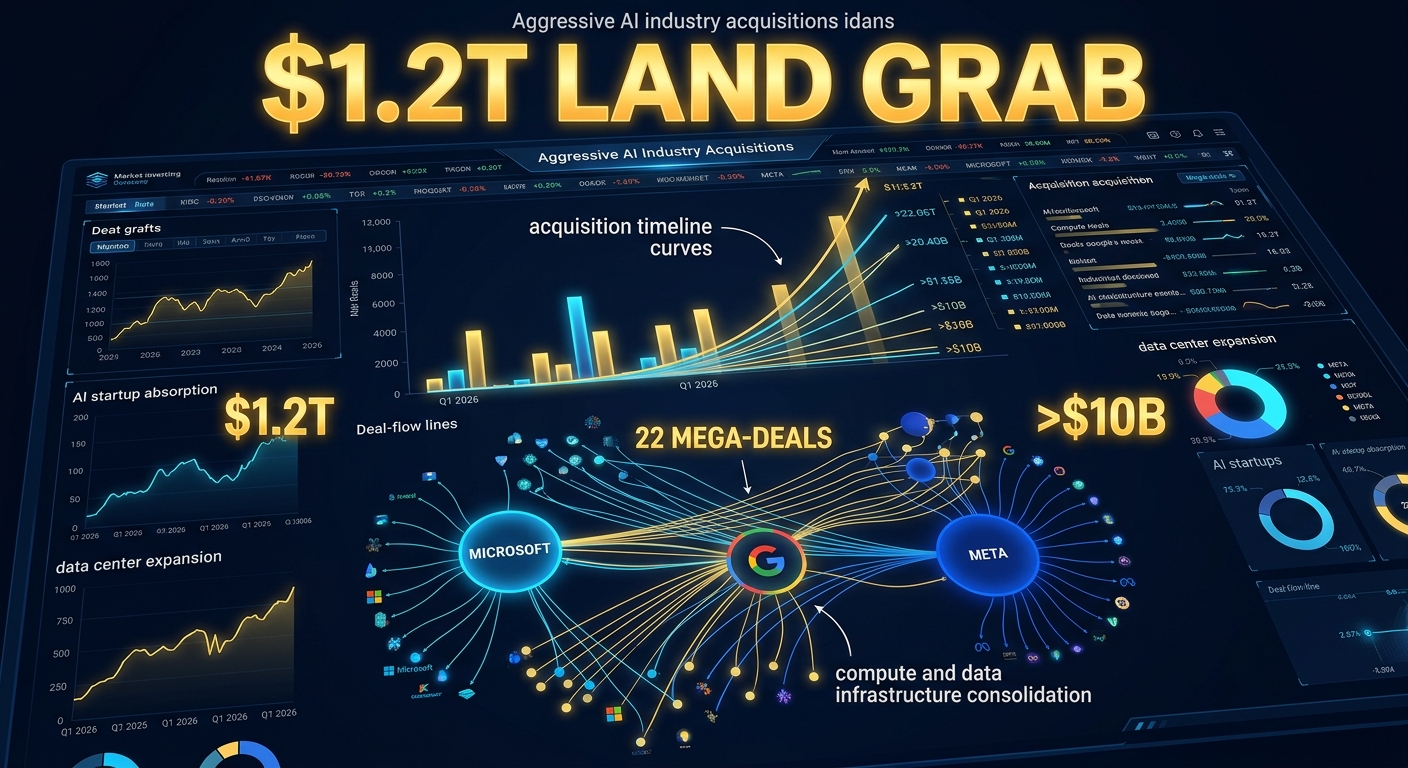
Q1 2026 closed with $1.22 trillion in global M&A — a 30% year-over-year surge driven almost entirely by one thing: companies racing to own the AI stack before someone else does. This isn’t speculative bubble activity. It’s survival-driven consolidation, and the window to understand who’s winning is right now.
For investors, the signal is clear: the biggest AI acquisitions 2026 has produced aren’t about acquiring talent or products — they’re about locking in compute, data rights, and energy infrastructure for the next decade. For builders, the implication is equally direct: the companies building on top of this infrastructure are increasingly dependent on a handful of players who now control the plumbing.
Market Overview
The scale of Q1 2026 M&A is hard to overstate. According to multiple market reports, global deal volume hit $1.22 trillion — the highest single quarter on record — with 22 mega-deals exceeding $10 billion each.
| Metric | Q1 2025 | Q1 2026 | Change |
|---|---|---|---|
| Global M&A volume | ~$940B | $1.22T | +30% YoY |
| AI-driven deals (share) | ~40% | ~81% | +41pp |
| Mega-deals (>$10B) | 14 | 22 | +57% |
| Cross-border transactions | baseline | +47% | structural shift |
In plain terms: four out of every five dollars spent on acquisitions in Q1 2026 had an AI rationale. This isn’t a sector trend — it’s a wholesale restructuring of how large companies compete. For investors, the TAM for “AI infrastructure ownership” has effectively become the entire enterprise technology market. For developers and builders, it means the tools and platforms you depend on are increasingly owned by the same five companies. This consolidation wave is closely tied to the broader AI venture capital trends reshaping where funding flows in 2026.
Key Players and Top Deals
The biggest AI acquisitions 2026 produced fall into two categories: infrastructure grabs and capability acquisitions. The infrastructure deals are larger and more strategically significant.
| Deal | Value | Acquirer | Strategic Rationale | Moat Gained |
|---|---|---|---|---|
| SpaceX + xAI merger | $250B | SpaceX/Musk | Compute + distribution at planetary scale | Proprietary data advantage |
| OpenAI funding round | $122B | Amazon, Nvidia, SoftBank | Lock in frontier model access | Model/technical differentiation |
| Anthropic Series G | $30B | GIC, Coatue, Broadcom | Hedge against OpenAI concentration | Model/technical differentiation |
| Google + Wiz | $32B | Alphabet | Cloud security across hybrid deployments | Enterprise customer lock-in |
| Meta + Scale AI (49%) | $14.8B | Meta | Human-AI evaluation data for training | Proprietary data advantage |
| IBM + Confluent | $11B | IBM | Real-time data streaming for agents | Enterprise customer lock-in |
| Salesforce + Informatica | $8B | Salesforce | Data governance for agentic AI | Enterprise customer lock-in |
| CoreWeave + Core Scientific | $9B | CoreWeave | Power infrastructure for compute scaling | Vertical domain depth |
The pattern across these deals is consistent: acquirers are buying multiple layers of the stack simultaneously — governance, real-time data, security, and execution environments. As index.dev’s analysis notes, “operationalizing models reliably at scale wins” over raw capability. Companies without ownership across these layers are increasingly dependent on those who do.
Trends
Infrastructure Ownership Replacing Talent Acquisition
The dominant pattern in AI consolidation deals 2026 is a shift from buying people to buying infrastructure. Microsoft’s $19.4B agreement with Nebius Group for European data center access, NVIDIA’s stakes in Marvell, Lumentum, and Coherent — these aren’t talent plays. They’re bets that whoever controls silicon photonics and power generation controls the cost curve for the next five years.
Why now: compute costs have become the primary competitive variable. The companies that locked in infrastructure at 2024 prices are now sitting on structural cost advantages their competitors can’t replicate quickly.
For investors, money is flowing toward “picks and shovels” — the infrastructure layer beneath the model layer. For builders, this means the open-source model ecosystem is increasingly dependent on closed infrastructure, which changes the calculus on what “open” actually means.
The “Buy or Die” Imperative Hits Mid-Market
McKinsey’s analysis frames 2026 AI M&A as entering an “industrial phase” — and the pressure is hitting mid-cap tech hardest. Companies without trillion-dollar balance sheets can’t compete in mega-deals, so they’re being squeezed: too large to be acquired cheaply, too small to acquire defensively.
The driver: 86% of organizations have integrated generative AI into M&A workflows (Deloitte), meaning AI capability is now table stakes for deal-making itself — not just a deal target.
For investors, mid-cap AI-adjacent companies face a binary outcome: get acquired or get disrupted. For builders, this is where the most interesting secondary opportunities are — the tooling layer serving companies that can’t afford to build their own stack. Understanding how to evaluate AI companies becomes essential when the acquisition window is this compressed.
Secondary Markets Diverging: Anthropic Up, OpenAI Cooling
TechCrunch reports that Anthropic is “the hardest stock to source” in secondary markets, with $2B ready to deploy and virtually no sellers — while OpenAI shares trade at a discount to their primary round valuation ($765B vs $852B). The community consensus on Hacker News reflects this skepticism: investors are questioning whether talent and data moats justify OpenAI’s valuation when multiple labs have produced comparable results with similar resources.
The SpaceX IPO (potentially $1.75T valuation, targeting June) adds a liquidity variable: it will absorb significant capital that might otherwise flow to Anthropic or OpenAI secondary positions.
Investment Implications
Opportunities
- Infrastructure layer consolidation: CoreWeave, data center operators, and energy providers supplying AI compute are in a structural bull market. The $9B CoreWeave + Core Scientific deal signals that power infrastructure is now priced as AI infrastructure — earlier-stage equivalents remain underpenetrated.
- Vertical AI agents: The Manus ($2B, Meta) and Quotient AI (Databricks) acquisitions signal that agentic workflow tooling is the next acquisition target category. Companies building domain-specific agents with proprietary workflow data have defensible moats that generalist platforms can’t easily replicate.
- Anthropic secondary exposure: With $2B in unmet demand and no sellers, Anthropic’s secondary market represents a rare case of genuine scarcity — unusual in a market where OpenAI supply exceeds demand.
Risks
- Regulatory overhang: CFIUS and the European Commission are increasingly treating AI infrastructure deals as national security questions. Deals involving semiconductor IP or critical data infrastructure face “gatekeeper” scrutiny that can delay or block transactions.
- Valuation multiple compression: 40x–50x revenue multiples for late-stage AI companies assume continued hyper-growth. Any slowdown in enterprise AI adoption converts these multiples into significant downside exposure. The AI unicorn bubble reality check covers this risk in depth.
FAQ
Are the biggest AI acquisitions 2026 a sign of a bubble?
The data suggests strategic consolidation rather than speculative excess. Unlike 2021’s cheap-money deals, Q1 2026 acquisitions are infrastructure-driven — companies buying compute capacity, data rights, and energy assets they need to operate. That said, valuation multiples of 40x–50x revenue leave limited margin for error if enterprise adoption slows.
Who are the biggest winners in AI M&A consolidation?
NVIDIA, Microsoft, and Alphabet are the primary beneficiaries — each holds stakes across multiple layers of the AI stack. Anthropic is the standout in private markets, with secondary demand significantly outpacing supply. Mid-cap tech without clear AI differentiation is the clearest loser category.
What does AI consolidation mean for startups and developers?
The infrastructure layer is consolidating fast, but the application layer remains fragmented. Startups building vertical-specific agents with proprietary workflow data are still acquirable targets — the Manus and Quotient AI deals confirm buyers are still paying for focused capability. The risk is dependency: building on infrastructure controlled by potential acquirers or competitors.
Outlook
The AI M&A strategy buy vs build decision is effectively over for large enterprises — the answer is buy, and the window to acquire at reasonable multiples is closing. By Q3 2026, we expect at least two additional mega-deals in the energy-AI intersection, as tech companies move from leasing power to owning generation capacity. Watch for Microsoft or Alphabet to announce a nuclear or renewable energy acquisition — both have signaled this direction in their infrastructure roadmaps.
For investors: the observable signal to watch is SpaceX’s IPO pricing in June. If it prices above $1.5T, it confirms that infrastructure-layer AI assets command a permanent premium — and the infrastructure acquisition wave has further to run. The AI startup funding trends for 2026 provide additional context on where capital is concentrating.
For builders: the skill combination that becomes scarcest in this consolidation wave is understanding both the infrastructure constraints and the application layer — not just one side of the stack. The biggest AI acquisitions 2026 are reshaping what “full-stack” means.
The infrastructure layer is largely locked up. The next $100B will be made in the application layer — and the window is still open.
References
- AI Boom Propels Global M&A to Record $1.2 Trillion in Q1 2026 — financialcontent.com, April 2026
- The $1.2 Trillion AI Land Grab: Q1 2026 M&A Smashes Records — financialcontent.com, April 2026
- Global M&A Surges to $1.2 Trillion in Q1 2026 — financialcontent.com, April 2026
- How 2025 Deals Shape 2026 Market — index.dev, January 2026
- Anthropic is having a moment in the private markets — TechCrunch, April 2026