SpaceX's $60B Cursor Deal: What It Means for AI Coding
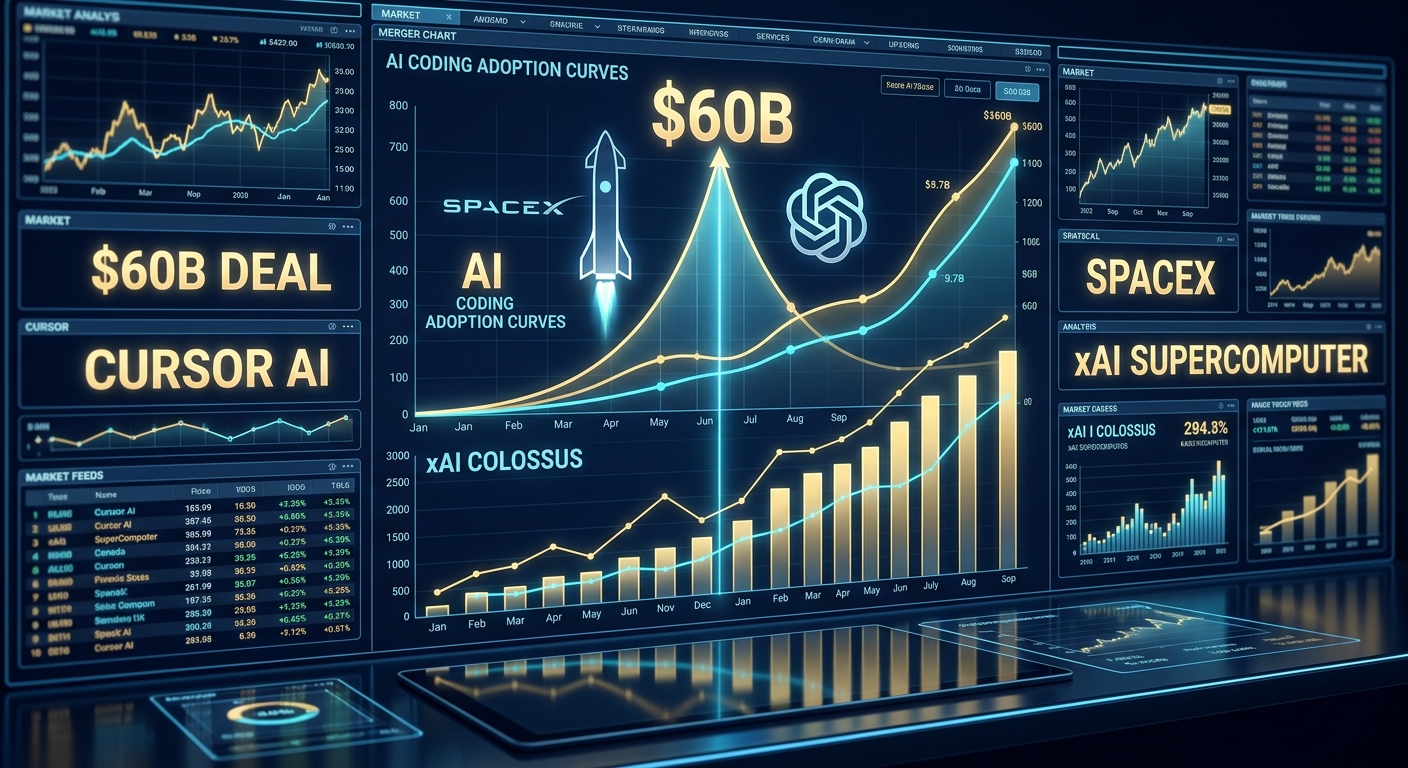
SpaceX just secured an option to acquire Cursor for $60 billion — or pay $10 billion for a partnership. That’s the largest breakup fee in history if the acquisition doesn’t close. For investors watching the AI coding space, this deal signals that the race to own developer workflows has entered a new phase. For watchers, it confirms that AI coding tools are no longer a niche — they’re strategic assets worth tens of billions.
Market Overview
The AI coding assistant market has exploded from a developer curiosity to a core enterprise tool category. Cursor alone has crossed 1 million daily active users and a $2 billion annual revenue run rate, according to PitchBook. The broader AI developer tools market is projected to reach $22.7 trillion in total addressable market opportunity — a figure SpaceX cited in its IPO filings. This mirrors the AI venture capital trends we’ve tracked throughout 2026.
| Metric | 2024 | 2025 | 2026E | 2027E |
|---|---|---|---|---|
| AI Coding Tools Market ($B) | 8.2 | 14.5 | 28.0 | 45.0 |
| Cursor ARR ($B) | 0.3 | 1.2 | 6.0 | 10.0+ |
| Enterprise Adoption Rate | 18% | 35% | 55% | 70% |
In plain terms: AI coding tools have moved from “nice to have” to “must have” for engineering teams. The 55% enterprise adoption rate expected by end of 2026 means more than half of Fortune 500 companies will have standardized on an AI coding assistant. For developers, this means proficiency with these tools is becoming a baseline expectation, not a differentiator.
The Deal Structure
The SpaceX-Cursor agreement is unusual. TechCrunch reports that Cursor was days away from closing a $2 billion funding round at a $50 billion valuation when SpaceX made its move. The deal gives SpaceX two options:
- Acquire Cursor for $60 billion later this year, likely after SpaceX’s IPO
- Pay $10 billion for a collaborative effort to train an AI coding model on xAI’s Colossus supercomputer
The acquisition is triggered only if the model training succeeds — making the $10 billion payment the largest breakup fee in history if it doesn’t, per PitchBook analyst Franco Granda. Either way, Cursor wins: they get either a $60 billion exit or $10 billion in capital to build their own model. This ranks among the biggest AI acquisitions of 2026.
SpaceX is delaying the acquisition until after its IPO this summer. The reason? Avoid updating confidential financial filings before the listing, and finance the $60 billion purchase using publicly traded stock rather than cash.
Key Players
| Company | Valuation | Latest Funding | Key Product | Growth Signal | Moat |
|---|---|---|---|---|---|
| Cursor | $60B (deal) | $2B round (preempted) | AI code editor | 1M+ DAU, $2B ARR | Developer ecosystem |
| GitHub Copilot | N/A (Microsoft) | — | Code completion | 1.8M paid users | Enterprise customer lock-in |
| Anthropic Claude Code | $60B | $8B (2026) | Agentic coding | 40% MoM API growth | Model differentiation |
| OpenAI Codex | N/A (OpenAI) | — | Code generation | Integrated in ChatGPT | Proprietary data advantage |
| Replit | $1.2B | $100M (2025) | Cloud IDE + AI | 25M developers | Developer ecosystem |
The competitive dynamics are shifting fast. Business Insider reports that Cursor faced a strategic dilemma: it relied on OpenAI and Anthropic models, but both companies are building competing coding products. As Alex Finn, founder of Henry Intelligent Machines, put it: “xAI has been behind on coding products for years. Cursor has a great coding product but will fail unless they build their own model.”
The deal solves both problems. SpaceX gets Cursor’s coding capabilities; Cursor gets access to xAI’s Colossus supercomputer to build a proprietary model.
Why This Deal Happened Now
xAI Needs a Coding Moat
xAI spent $13 billion on chips and datacenters in 2025 and projects unprofitability until at least 2029, according to PitchBook. Despite this investment, xAI has no competitive coding product. Cursor fills that gap instantly.
For investors, this signals that AI infrastructure alone isn’t enough — application-layer assets with user lock-in are now the acquisition targets. For developers, it means the tools you use daily are becoming strategic chess pieces in a larger game.
Cursor’s Dependency Problem
Cursor’s core product runs on Claude and GPT models. But Anthropic launched Claude Code, and OpenAI has Codex. TechCrunch notes that “despite fast revenue growth, Cursor is facing fierce competition from Anthropic’s Claude Code and OpenAI’s Codex.”
Building your own model requires massive compute. The SpaceX deal gives Cursor access to Colossus — one of the largest AI training clusters in existence.
The IPO Timing
SpaceX filed for IPO on April 1, 2026, targeting a $1.75 trillion valuation and $75 billion fundraise — potentially the biggest IPO in history. Acquiring Cursor with stock rather than cash makes the deal more palatable for SpaceX’s balance sheet. For context on how this compares to other AI company valuations, Cursor’s $60B price tag implies 10x forward revenue.
Investment Implications
Opportunities
- AI coding infrastructure plays: Companies providing the compute and tooling layer for AI coding (GPU cloud, fine-tuning platforms) benefit regardless of which coding assistant wins. The market is growing 90%+ YoY.
- Vertical AI coding tools: General-purpose assistants are consolidating, but vertical-specific coding tools (healthcare, fintech, embedded systems) remain underpenetrated. Expect M&A activity here.
- Developer workflow integration: The real moat is owning the developer’s daily workflow. Companies that integrate AI coding into CI/CD, testing, and deployment have stickier products.
Risks
- Valuation compression: A $60 billion price for Cursor implies 10x forward revenue on projected $6B ARR. If AI coding growth slows, these multiples won’t hold.
- Model commoditization: If open-source coding models catch up (Llama Code, StarCoder), the differentiation shifts to UX and integration — lower-margin businesses.
- Regulatory scrutiny: A SpaceX-Cursor deal may face antitrust review, especially given SpaceX’s existing xAI ownership and government contracts.
FAQ
Is SpaceX-Cursor a good investment signal in 2026?
Yes, but with caveats. The deal validates AI coding as a strategic category worth $60B+ valuations. However, the unusual structure (acquisition contingent on model training success) introduces execution risk. Watch whether the Colossus training delivers results by Q3 2026.
What is the market size of AI coding tools?
The AI coding assistant market is projected to reach $28 billion in 2026 and $45 billion by 2027, growing at 90%+ annually. Enterprise adoption is the primary driver, with 55% of Fortune 500 companies expected to standardize on AI coding tools by year-end.
Who are the key players in AI coding?
Cursor, GitHub Copilot, Anthropic Claude Code, OpenAI Codex, and Replit lead the market. The SpaceX-Cursor deal reshuffles the competitive landscape by giving Cursor access to proprietary compute infrastructure.
What are the biggest risks in AI coding investments?
Valuation risk (10x forward revenue multiples), model commoditization from open-source alternatives, and regulatory scrutiny of large acquisitions. The dependency on foundation model providers (OpenAI, Anthropic) is also a structural risk for standalone coding tools.
How do I break into AI coding as a developer?
Master one AI coding assistant deeply (Cursor or Copilot), then learn prompt engineering for code generation. The scarcest skill combination in 2026 is AI coding proficiency + domain expertise (fintech, healthcare, embedded systems). Generalist AI coding skills are becoming commoditized; vertical specialization is where the premium is.
Outlook
By Q4 2026, we expect the SpaceX-Cursor deal to either close or convert to the $10 billion partnership. The key indicator: whether Cursor’s model training on Colossus produces a competitive coding model by September. If it does, expect the acquisition to proceed. If not, Cursor still walks away with $10 billion — enough to build independently.
The broader signal is clear: AI coding tools are no longer standalone products. They’re becoming integrated into larger AI ecosystems (xAI, OpenAI, Anthropic). Standalone coding startups without proprietary models or strategic partnerships will face increasing pressure.
For investors: Watch Cursor’s model training progress and SpaceX’s IPO pricing. If SpaceX prices above $1.5 trillion, the Cursor acquisition becomes more likely — stock-based deals are easier at higher valuations.
For watchers: The window to differentiate on AI coding skills is narrowing. Focus on vertical specialization (healthcare AI, fintech AI) rather than general-purpose coding assistance. The generalist AI coding market is consolidating; the vertical markets are just opening.
The infrastructure layer is largely built. The next $100 billion in AI coding will be made in the application layer — and the SpaceX-Cursor deal just raised the stakes for everyone else.