US vs China AI Race 2026: Who Is Actually Winning?
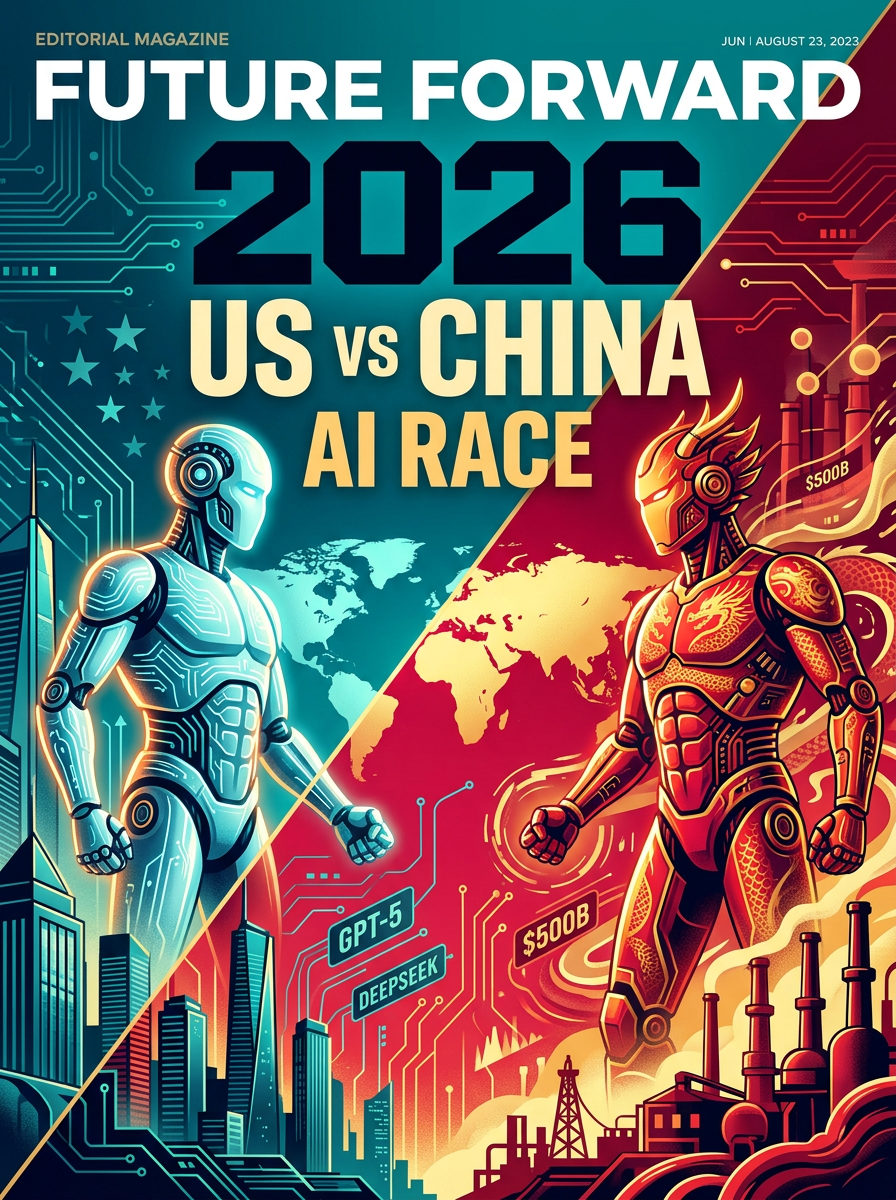
The question of who’s winning the US-China AI race doesn’t have a simple answer in 2026. Both superpowers lead in different dimensions, and the scoreboard changes depending on which metrics you prioritize.
The Multi-Dimensional Race
According to recent analysis from the Brookings Institution, the US-China AI competition unfolds across multiple dimensions: compute, models, adoption, integration, and deployment. The US still produces more top-tier AI models and higher-impact patents, while China leads in publication volume, citations, and patent output.
A striking statistic circulating on industry channels: China now represents 74% of all AI patent grants globally, with the US accounting for just 12%. However, patent volume doesn’t equal patent quality or commercial viability.
The Chip Export Control Gambit
The US Commerce Department continues tightening the screws on semiconductor exports. In late May 2026, guidance clarified that bans on AI chip shipments apply to Chinese firms operating outside China, closing a potential loophole that allowed hundreds of thousands of chips to reach Chinese entities through overseas subsidiaries.
These controls reflect a multi-year strategy. The US implemented unprecedented restrictions on semiconductor exports to China in October 2022, expanded in 2023 and 2024, with further tightening in 2025-2026. The explicit goal: impair Chinese capabilities in AI and supercomputing by cutting off access to high-end chips.
But Chatham House analysts argue that chip export controls alone won’t prevent China from further developing advanced AI. The evidence supports this skepticism.
The DeepSeek Disruption
The most dramatic challenge to US AI dominance came from an unexpected source. DeepSeek, a Chinese startup, demonstrated that competitive AI models could be built at a fraction of the cost of American systems like ChatGPT and Gemini.
When DeepSeek unveiled R1 in January 2025, it triggered a 3% decline in the tech-heavy Nasdaq index. AI stocks went into freefall as markets grappled with the implications: maybe the AI race wasn’t purely about compute scale.
DeepSeek shattered the assumption that AI progress must come with skyrocketing costs. This forced a reevaluation of the entire competitive landscape—and raised uncomfortable questions about whether US strategy was too focused on hardware chokepoints.
However, DeepSeek’s April 2026 release of V4 received a more muted market response, facing strong competition from domestic rivals like Kimi.
Different Races, Different Winners
The BBC’s framing captures the nuance well: China is winning one AI race while the US wins another.
In terms of raw market power, the US maintains clear advantages. US companies dominate the $50B+ market cap AI firms, lead in cloud infrastructure for AI deployment, and retain most elite AI researchers from top institutions.
China’s advantages lie elsewhere:
- Cost efficiency: Building competitive models with smaller budgets
- Publication volume: Dominating academic AI research output
- Patent applications: Filing more AI-related patents globally
- Global South appeal: Foreign Policy reports that cutting-edge US models are too expensive for much of the developing world, creating openings for Chinese alternatives
Strategic Implications for Investors
For those tracking the AI venture capital trends in 2026, the geopolitical dimension cannot be ignored. Investment flows increasingly factor in regulatory risk, export control exposure, and supply chain vulnerabilities.
The AI chip design sector sits at ground zero of this competition. US restrictions on Nvidia’s high-end chips drove China to accelerate domestic alternatives, including Huawei’s Ascend series—though Commerce Department guidance now explicitly states that using Ascend chips violates US export controls for certain applications.
Companies evaluating how to position AI investments must consider geopolitical exposure as a core risk factor.
The Bottom Line
Neither country has “won” the AI race, and framing it as a binary contest oversimplifies reality. The US leads in:
- Top-tier model capabilities
- AI chip production and market control
- Private sector market capitalization
China leads in:
- Research publication volume and patent grants
- Cost-efficient model development
- Emerging market AI adoption potential
The winner, as analyst Stephen Roach notes, may ultimately be the country that provides greater support for basic research—in which case China’s centralized approach gives it structural advantages.
For industry watchers and investors, the takeaway is clear: this isn’t a race with a finish line. It’s a long-term competition across multiple fronts where leadership shifts depending on which metric you’re measuring.
Sources
- Brookings Institution - Analysis of competing AI strategies
- CS Monitor - US-China AI competition reporting
- Al Jazeera - Export control guidance coverage
- Law & Economics Center - Export controls analysis
- CSIS - Strategic assessment
- Chatham House - Policy analysis
- GSU News - DeepSeek analysis
- Bank of America Private Bank - Market impact assessment
- CNBC - Market reaction coverage
- Reuters - DeepSeek V4 coverage
- BBC - Race dynamics analysis
- Foreign Policy - Global AI market analysis
- Congress.gov - Official export controls documentation
- Stephen Roach Substack - Economic analysis